
Chocolate Bhutlah Pepper, a Brown Superhot With No Lab Test
A lumpy chocolate-brown pod with smoky ghost-pepper flavor and a heat nobody has published a lab result for.
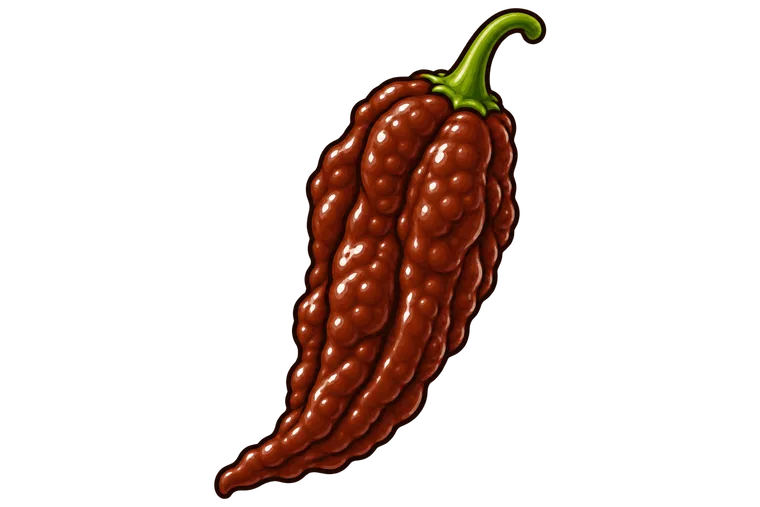
Superhot by parentage, but its heat is unmeasured: sellers claim 800,000 to 2,000,000 SHU
- Its parent Bhut Jolokia measured 1,001,304 SHU in NMSU's 2005 trial; no Guinness or lab record exists for the Bhutlah
- 110–120+ days to harvest; pods ripen from green to deep chocolate brown
- Flavor
- Smoky, sweet undertone2
On this page
- 1Who has measured the Chocolate Bhutlah's heat?
- 2Where does the Bhutlah name come from?
- 3How do you tell a Bhutlah from a ghost pepper?
- 4What does a Chocolate Bhutlah taste like?
- 5How do you handle a pod this hot in the kitchen?
- 6How do you grow a Chocolate Bhutlah from seed?
- 7Which brown superhot should you grow instead?
- 8What if a bite of Bhutlah is too much?
- 9Where to go after your first Bhutlah
Who has measured the Chocolate Bhutlah's heat?
Nobody, as far as any published source shows. Its two best-known seed sellers print heat ranges that barely overlap, and one of them says outright that no official test of the pepper exists2. That's why the index shows no Scoville bar for it.
| Pepper | Figure | Who says so | Kind of figure |
|---|---|---|---|
| Chocolate Bhutlah | 1,500,000–2,000,000 SHU | Reimer Seeds, 'claimed to be one of the hottest' | Seller label 1 |
| Chocolate Bhutlah | 800,000–1,001,304+ SHU | Pepper Joe's, which says no official test exists | Seller estimate 2 |
| Bhut Jolokia (parent) | 1,001,304 SHU | NMSU replicated field trial, HPLC, 2005 | Peer-reviewed measurement 3 |
| Chocolate 7 Pot (parent's family) | 1.8 million SHU | NMSU Chile Pepper Institute | Institute test 4 |
Look closely at Pepper Joe's upper number. 1,001,304 is exactly the figure NMSU measured for the Bhut Jolokia, the Bhutlah's red parent, in a 2005 trial at Las Cruces3. So that range borrows a parent's lab result; it doesn't come from testing the Bhutlah itself.
Read every Bhutlah heat number as a guess from its parents, because no one has published a test of the pod itself.
What can you reasonably expect? Its parents sit at about one million and 1.8 million SHU in NMSU's tests34, so a cross between them very likely lands in the superhot band. How far it climbs within that band is anyone's guess until somebody sends pods to a lab.
Log scale; bars are published ranges.Sources for this line3. HortScience 42(2):222-2245. New Mexico State University News Center6. PhytoKeys 200:1-423 (Pensoft)7. Guinness World Records
It holds no record either. Guinness's current record holder is Pepper X, rated at an average of 2,693,000 SHU in tests at Winthrop University in 20237, and no Guinness page we read mentions the Bhutlah. For how the title has passed from pepper to pepper, the record history lays out each holder.
Is the Chocolate Bhutlah hotter than a Carolina Reaper?
You can't know until someone tests it. Guinness confirmed the Carolina Reaper at an average of 1,569,300 SHU in 20138. Reimer's top claim of 2,000,000 SHU for the Bhutlah would beat that, while Pepper Joe's estimate of 800,000 to about a million would leave it well behind12.
So the honest answer splits by source. If you're choosing a pepper for a dare or a sauce label, the Reaper is the one with a confirmed number, and you know roughly what you're getting. The Bhutlah could be milder or hotter in your garden, and one plant can differ from the next, as NMSU's tests of other superhot crosses show.
If you grow both, you can run your own rough test: make two identical small batches of sauce, one with each pod by weight, and taste them a day apart. It won't give you a Scoville number, but it will tell you which one your family can handle.
Where does the Bhutlah name come from?
From its two parents. Reimer Seeds describes it as a cross between the Bhut Jolokia and the 7 Pot Douglah1, and the name joins the two: "Bhut" plus the end of "Douglah". Pepper Joe's agrees on the Douglah side and calls the pepper a variant of the red ghost pepper2.
The sellers don't agree on where it's from. Reimer lists India as its country of origin, while Pepper Joe's lists Bangladesh12. Neither names a breeder or a year, and we found no breeder's own page. Hobby forums tell several stories about who made the first cross, but none come with a primary source, so we leave them out.
The parentage fits the pod you see. NMSU describes the Bhut Jolokia as an elongated fruit with an undulating surface3, and the Bhutlah keeps that uneven, wrinkled skin while ripening brown instead of red.
How do you tell a Bhutlah from a ghost pepper?
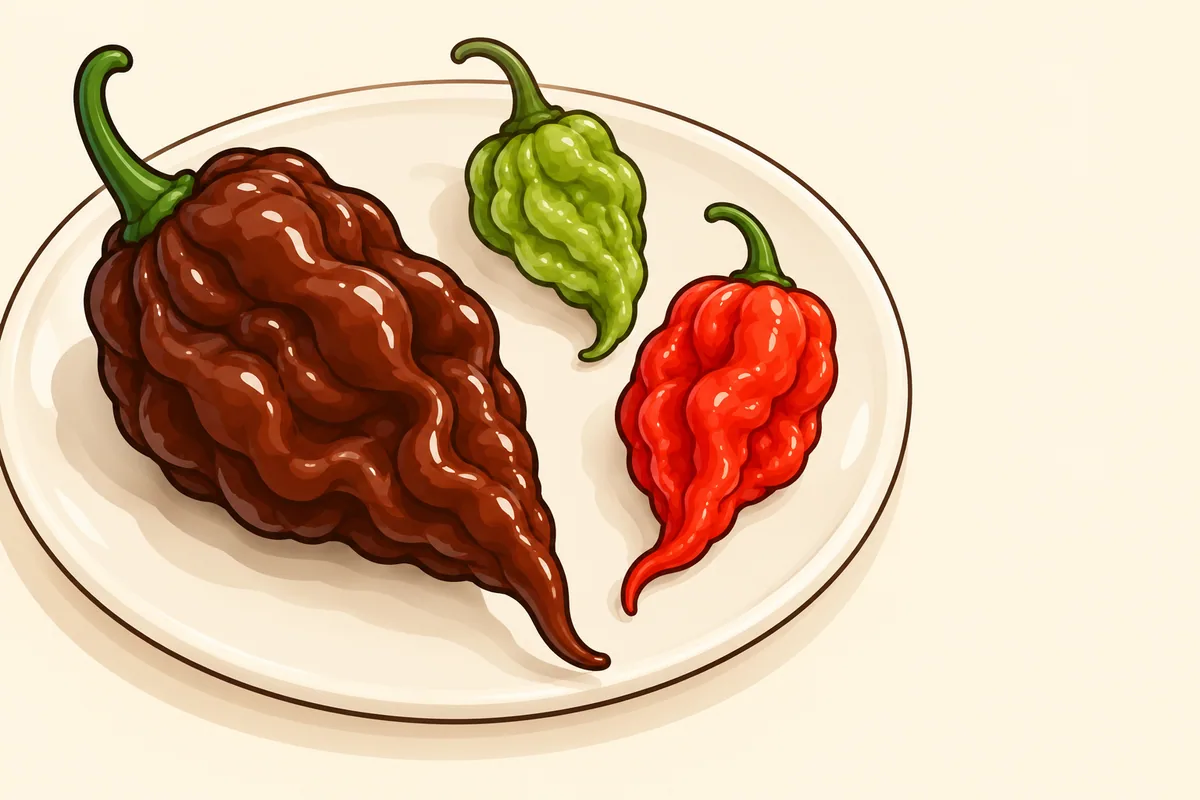
By color first, then shape. Here are the two pods side by side, from the sellers' descriptions and NMSU's description of the ghost pepper:
Chocolate Bhutlah
Bhut Jolokia (ghost)
- Green, ripening to deep chocolate brownColorGreen, ripening to bright red
- Irregular, wrinkled, pointed tailShapeElongated, with an undulating surface
- About 2½ in long and 1½ in wide (Reimer); about 3 in (Pepper Joe's)Size5–8 cm long
- No published testHeat1,001,304 SHU in NMSU's 2005 trial
A green Bhutlah and a green ghost look a lot alike, so don't judge an unripe pod. Wait until it colors: if it turns red, you have a ghost or a red cross; if it turns brown, you have a chocolate type. Reimer describes the ripe Bhutlah as a deep chocolate brown with irregular, wrinkled pods1.
What does a Chocolate Bhutlah taste like?
Like a ghost pepper with a darker, sweeter edge. Pepper Joe's says its rich dark color comes with sweeter undertones on top of the smoky flavor typical of ghost peppers2. That's a seller's description, so treat it as a guide, not a lab profile.
Both sellers list the same kind of uses. Reimer suggests pickling, salsa, hot sauce and seasoning powder1; Pepper Joe's adds BBQ sauces and marinades2. All of those spread one pod across a whole batch, which is how you use a superhot without making dinner painful.
Brown pods make dark sauces. A Bhutlah blended into a tomato or fruit base turns it a muddy red-brown, so pair it with dark ingredients you'd expect in a BBQ sauce: molasses, tamarind, coffee or smoked paprika. If you want a bright orange bottle, choose a yellow or orange superhot instead.
Dried and ground, the brown pods give you a dark powder that looks like cocoa in the jar. Label it clearly and keep it on a high shelf, because nobody in your house should mistake it for a sweet spice.
- Smoky
- Sweet undertone
- Superhot
How do you handle a pod this hot in the kitchen?
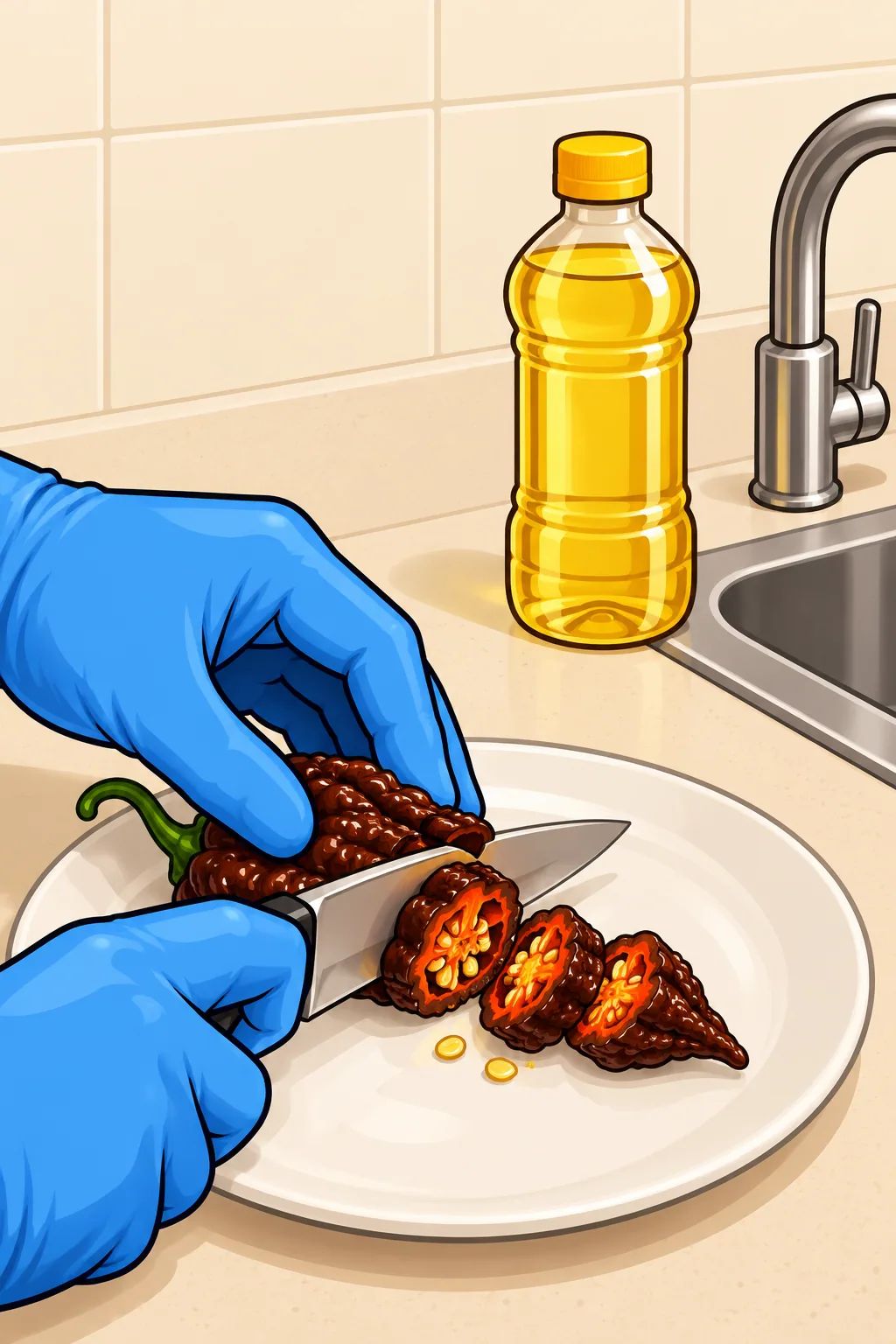
Treat it like the ghost pepper it partly is, or hotter. Start with the gloves Poison Control recommends for any hot pepper9, then dilute hard.
- 1
Glove both hands
Wear rubber, latex or nitrile gloves before you cut a pod.9
- 2
Cut on a plate you can wash
Use a glass or ceramic plate rather than a wooden board, which holds the oils.
- 3
Use a sliver
For a pot of BBQ sauce, start with a piece no bigger than your thumbnail and taste after it simmers.
- 4
Blend into a lot of base
One whole pod can season a full bottle of hot sauce; build the base first, then add the pepper in pieces.
- 5
Dry the extras outdoors
Grind powder outside or by an open window, since the dust reaches your eyes and throat fast.
If you plan to bottle a sauce, the fermented hot sauce method works well with superhots: you can ferment a mild base and blend in a small piece of Bhutlah at the end, so the heat stays under your control.
How do you grow a Chocolate Bhutlah from seed?
Slowly, with warmth, and with patience in summer. Reimer's planting notes give you the numbers1:
- 1
Sow shallow and warm
Sow seeds 1/4 inch deep and keep them at 80–85 °F; expect sprouts in 14–28 days.1
- 2
Use a seed-starting mix
Reimer advises against garden potting soil and peat plugs for germination.1
- 3
Plant out in full sun
Move plants outdoors in spring once nights stay warm, into full sun.1
- 4
Water deeply in heat waves
Soak the soil thoroughly during dry, hot spells.1
- 5
Pick ripe pods often
Picking pods as they mature encourages the plant to set new buds.1
Plan for a long wait. Reimer lists 120+ days to harvest and Pepper Joe's 110–120+12, so in a short summer you'll want seedlings started indoors early in the year. The seed starting hub shows how to set up heat mats and light for slow superhot seed.
Plant size depends on whom you ask. Reimer prints both 18 to 24 inches and 1 to 7 feet on the same page, and Pepper Joe's says about 4 feet12. Give it a 5-gallon pot and a stake, and you'll be ready for the larger end.
Which brown superhot should you grow instead?
If you want a number you can trust, pick one that a lab has tested. This table puts the Bhutlah beside measured peppers from its family:
| Pepper | Heat | Kind of figure | Pick it if… |
|---|---|---|---|
| Chocolate 7 Pot4 | 1.8 million SHU | NMSU Chile Pepper Institute test | You want the hottest tested brown pod |
| Bhut Jolokia (red)3 | 1,001,304 SHU | Peer-reviewed HPLC trial | You want the Bhutlah's known parent |
| Chocolate Habanero4 | 700,000 SHU | NMSU Chile Pepper Institute test | You want brown color with less risk |
| Chocolate Bhutlah12 | Unmeasured; sellers claim 0.8–2 million | Seller labels | You want the look and the story |
NMSU's own numbers show why the label matters. Its Chocolate 7 Pot and Red 7 Pot sit more than a million SHU apart4, so a cross of two superhots can land almost anywhere. For the whole field of tested superhots, the superhot list sorts them by heat.
What if a bite of Bhutlah is too much?
Stop, sip, and wait it out; most reactions pass, but some need help.
For burning hands, Poison Control lists warm water, vegetable oil or a soak in diluted vinegar9. Keep a bottle of oil by the sink before you start cutting, not after.
Where to go after your first Bhutlah
Grow one plant beside a red Bhut Jolokia if you can, so you see the color split for yourself and taste the two side by side. If you'd rather grow a superhot whose heat a university measured, the Trinidad Moruga Scorpion has a peer-reviewed figure. The Komodo Dragon is the opposite case, a superhot that, like the Bhutlah, rests on its seller's number.
Related peppers
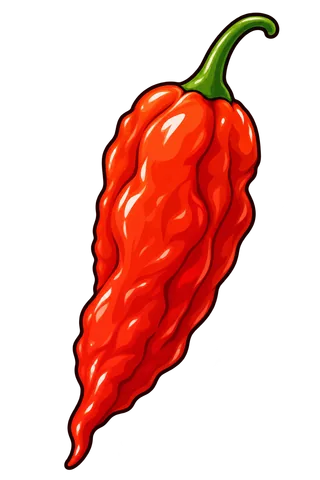 Ghost pepperSuper-hot1,001,304 SHU averageKomodo Dragon pepperSuper-hot1,400,000 SHU
 Carolina ReaperSuper-hot1,641,183 SHU average
 Trinidad Moruga ScorpionSuper-hot1,200,000–2,000,000 SHU
Published ranges.Sources for this line3. HortScience 42(2):222-2245. New Mexico State University News Center6. PhytoKeys 200:1-423 (Pensoft)10. Reimer Seeds (seed seller's product page for its own seed)
Related in Peppers
-
Pepper X Scoville, 2.69 Million SHU and Record
Ed Currie's record pepper from South Carolina, at an average of 2.69 million SHU.5 min read -
Dragon's Breath Pepper, a 2.48M SHU Claim Never Verified
A small red superhot shown at the Chelsea Flower Show in 2017, whose famous number never came with a test report.6 min read -
Paprika Scoville Heat, Sweet Under 500 SHU or Hot Over 8,000
A ground red pepper sold for color first and heat second.7 min read -
Habanero Pepper Scoville, 100,000–350,000 SHU
A fruity, floral chile in the extra-hot band.7 min read -
Jalapeño Scoville, 2,000–8,000 SHU and Chipotle
The medium-heat chile most heat comparisons start from.6 min read -
Ñora Pepper, Sweet Pimentón Pod Under 480 SHU
The small round sweet pepper behind Murcia's pimentón.5 min read
Sources
· 10
- 1Reimer Seeds (seed seller's product page for its own seed) Bhutlah Chocolate Pepper Seeds
- 2Pepper Joe's (seed seller's product page for its own seed) Chocolate Bhutlah Seeds
- 3HortScience 42(2):222-224 'Bhut Jolokia', the world's hottest known chile pepper, is a putative naturally occurring interspecific hybrid (Bosland and Baral)
- 4New Mexico State University, Chile Pepper Institute Heat
- 5New Mexico State University News Center NMSU's Chile Pepper Institute names the Trinidad Moruga Scorpion hottest pepper on earth (Justin Bannister)
- 6PhytoKeys 200:1-423 (Pensoft) Monograph of wild and cultivated chili peppers (Capsicum L., Solanaceae)
- 7Guinness World Records Pepper X dethrones Carolina Reaper as world's hottest chilli pepper
- 8Guinness World Records Confirmed: Smokin Ed's Carolina Reaper sets new record for hottest chilli
- 9National Capital Poison Center (Poison Control) Capsaicin: when the chili is too hot
- 10Reimer Seeds (seed seller's product page for its own seed) Komodo Dragon Pepper Seeds