
Padrón Peppers vs Shishito, 1,417 SHU and a 1-in-10 Gamble
Two small green pan peppers, two different reasons the odd one burns.
Both are mild Capsicum annuum pan peppers with an occasional hot pod. A Padrón tested 1,417 SHU in one lab; no lab publishes an SHU figure for shishito.
- A Padrón is short and stubby, 3.5–5.5 cm and 3.5–4.5 g; a shishito runs about 3 to 3½ inches
- Padróns get hotter as they ripen red; shishitos get hotter when a fruit sets few or no seeds
- Swap one for the other gram for gram and cook both whole in a hot pan
On this page
- 1Which bites harder, a Padrón or a shishito?
- 2Why can't the Padrón and shishito lab numbers sit on one scale?
- 3How do Herbón growers keep their Padróns mostly mild?
- 4What turns a mild shishito into a hot one?
- 5How do the two pods differ on the cutting board?
- 6How many Padróns fill a 400 g bag, and how do you swap by weight?
- 7Should your tapas plate or your skewers get the Padrón?
- 8Can you grow a Galician Padrón season next to a shishito row?
Which bites harder, a Padrón or a shishito?
On the evidence, the Padrón, by a little and only sometimes. One Portuguese trial measured a Padrón at 1,417 SHU, the mildest of the 71 peppers it tested1. No lab we found prints an SHU figure for a shishito, and one seed seller describes its organic shishito as having no heat at all2.
What the two share is the surprise pod your guests talk about. The Galician rule for Padróns is "uns pican e outros non", some bite and some don't3, and UC Master Gardeners put the shishito's odds at about 1 in 104. So on any plate you serve, expect a pod or two to sting whichever bag you bought.
| Pepper | What was tested | Result | Unit |
|---|---|---|---|
| Padrón1 | Whole pods, potted plants in Portugal | 1,417 | SHU |
| Padrón, green5 | Flesh (pericarp) | 2.14 | µg capsaicinoids per g fresh weight |
| Padrón, green5 | Placenta | 277 | µg per g fresh weight |
| Padrón, red5 | Flesh | 25.5 | µg per g fresh weight |
| Padrón, red5 | Placenta | 720 | µg per g fresh weight |
| Shishito, normal seeded fruit6 | Placental septum | below 1,360 | µg per g dry weight |
| Shishito, seedless fruit6 | Placental septum | 258–3,204 | µg per g dry weight |
Look at the unit column before you compare rows. The Padrón figures from Spain count fresh tissue, while the shishito figures from Japan count dried placenta only, so the bigger numbers on your shishito rows do not mean a hotter pepper. Both are mild peppers that hide their heat in the pale ribs, and both throw the odd hot pod.
Why can't the Padrón and shishito lab numbers sit on one scale?
Because water and tissue change the count. A Herbón Padrón holds 91 % water by weight3, so a gram of the fresh pod in your hand carries far less of everything than a gram of dried pod. The Japanese team also measured only the placental septum, the part with the most heat6, while you eat the whole pepper.
To turn the dry figures into fresh ones, you would need the water content of the shishito's placenta, and the paper does not give it. We leave the conversion out rather than guess. What you can trust are the ratios inside each study, since each lab compared like with like:
So ripeness is your big lever with a Padrón, and seeds are the big lever with a shishito. The Spanish study notes that people eat Padróns green and leave the red ones alone because of their strong pungency5; if your bag has started to turn red, save those pods for a sauce. A shishito, even at its seedless worst, stayed well under the hot Japanese Takanotsume grown beside it6.
How do Herbón growers keep their Padróns mostly mild?
They select for it every year. The specification for the protected Pemento de Herbón says the local Padrón started out as a hot variety, and that growers removed the plants and fruits with stronger heat until only a light bite remained3. Here is their method, step by step, so you can see where your mild bag comes from:
- 1
Taste the seed plants raw
Growers taste raw pods from the plants they picked as seed parents to check the heat, keeping a mild line and accepting a few slightly hot pods.3
- 2
Save seed from red, ripe pods
They let the chosen pods ripen red, soak them in water so the seeds come off the placenta, and dry the seeds fast.3
- 3
Water at the foot of the plant
Heat above 30 °C with dry air and dry soil raises capsaicin in the fruit, so growers water evenly and keep water off the flowers.3
- 4
Pick young and sort by hand
Pods come off green and immature, by hand, every day in peak season, then packers sort them one by one before bagging.3
That last sort is the part you can copy at your own counter. The packers pull out the pods they expect to burn, and the specification lists the signs they use3:
Signs of a hot Padrón, from the Herbón packers' sort
None of these signs is a promise, so treat them as odds. If you are cooking for someone who hates heat, set the pale, curved, tight ones aside and eat them yourself.
What turns a mild shishito into a hot one?
Mostly a shortage of seeds. In Japan, seedless shishitos even have a name, "stone fruits", and growers have long known they tend to burn6. When the Shinshu University team forced seedless fruit with a plant hormone, those fruits held more capsaicinoids than seeded ones and swung far more from pod to pod6.
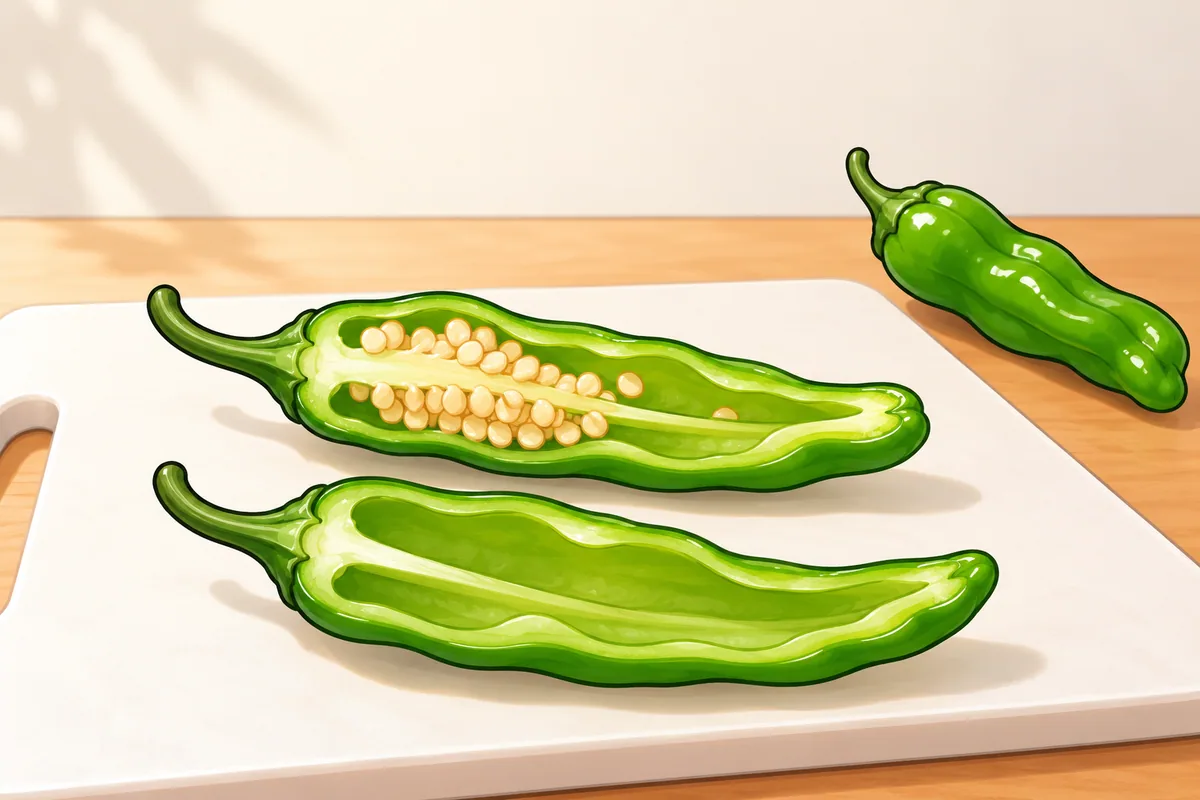
The same paper cites earlier Japanese work in which round-the-clock light, and high temperatures at night, raised the share of hot fruit6. If your problem is a pepper you can't find, the shishito swaps go further into the genetics and list what to buy instead.
So your shishito gamble comes from how the fruit set, while your Padrón gamble comes from age and stress. In both cases a pod with fewer seeds is the one to taste first: cut one open, and if you see only a few seeds clinging to the ribs, take a small bite before you plate the batch.
How do the two pods differ on the cutting board?
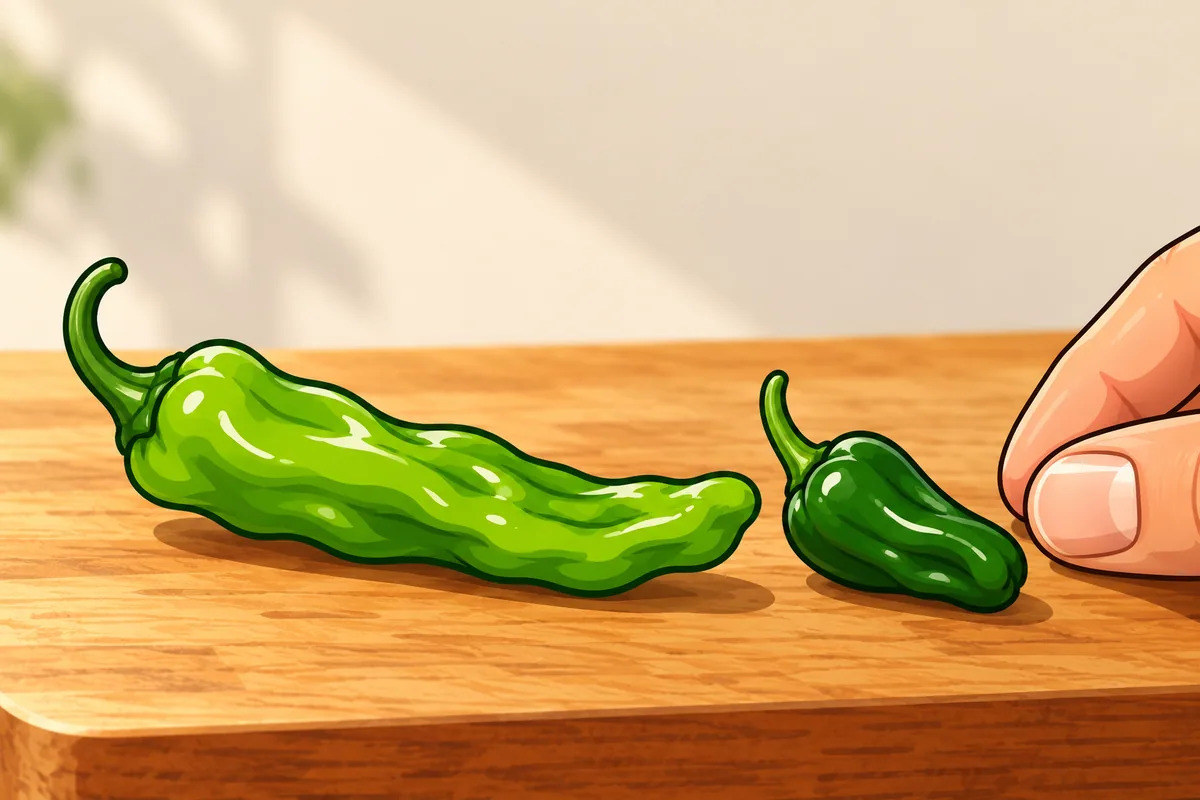
A shishito is about twice as long. The Herbón specification sets a Padrón at 3.5 to 5.5 cm long and 1.5 to 2 cm wide3, while Johnny's organic shishito averages 3 to 3½ inches, about 7.5 to 9 cm2.
Padrón (Pemento de Herbón)
Shishito
- 3.5–5.5 cm, short and stubby3LengthAbout 3–3½ inches2
- 3.5–4.5 g per pod3WeightNot published; weigh your own2
- Three or four lobes and a sunken tip3ShapeSlender and slightly narrow2
- Thin, about 1.5 mm3WallThin2
- Mild, slightly sweet and grassy4FlavorMild, slightly sweet and smoky4
- Sautéed in olive oil and served as tapas4Usual dishRoasted, grilled, stir-fried or sautéed, cooked green24
Both have thin walls, which is why both blister in a few minutes in your hot pan. The longer shishito sits flat on a grill or a skewer, while the short Padrón rolls around and cooks evenly in a skillet.
The Padrón's long stem helps you too: the specification wants a 3.5 to 6 cm stalk on every pod3. You hold the stem, eat the pod and leave the stem on the plate. Shishitos have shorter stems, so on a skewer you thread them through the shoulder instead.
How many Padróns fill a 400 g bag, and how do you swap by weight?
Somewhere between 89 and 114. Herbón Padróns go to market in bags of about 400 g, and each pod weighs 3.5 to 4.5 g3, so 400 ÷ 4.5 gives 89 and 400 ÷ 3.5 gives 114. Count on your bag to fill two generous plates.
You swap gram for gram, because both are mild pan peppers with thin walls. Here is the arithmetic for the amounts your recipes are likely to ask for:
| Recipe asks for | Use instead | Padrón pod count | Hot pods to expect |
|---|---|---|---|
| 200 g shishitos, a plate for two3 | 200 g Padróns | 44–57 pods | Some; no share published |
| 400 g bag of Padróns34 | 400 g shishitos | 89–114 pods replaced | About 1 in 10 shishitos |
| 20 shishitos on skewers34 | 20 Padróns, about 70–90 g | 20 pods | About 2 of 20 shishitos |
Your cook times stay close, since both walls are thin. Pull the Padróns a little earlier than you would long shishitos, because the short pods blister all over faster. Salt both at the end, when the skins have puckered, so the salt sticks to the oil.
Should your tapas plate or your skewers get the Padrón?
Pick by the dish and by who sits at the table. UC Master Gardeners tie the Padrón to tapas fried in olive oil and the shishito to roasting and grilling4:
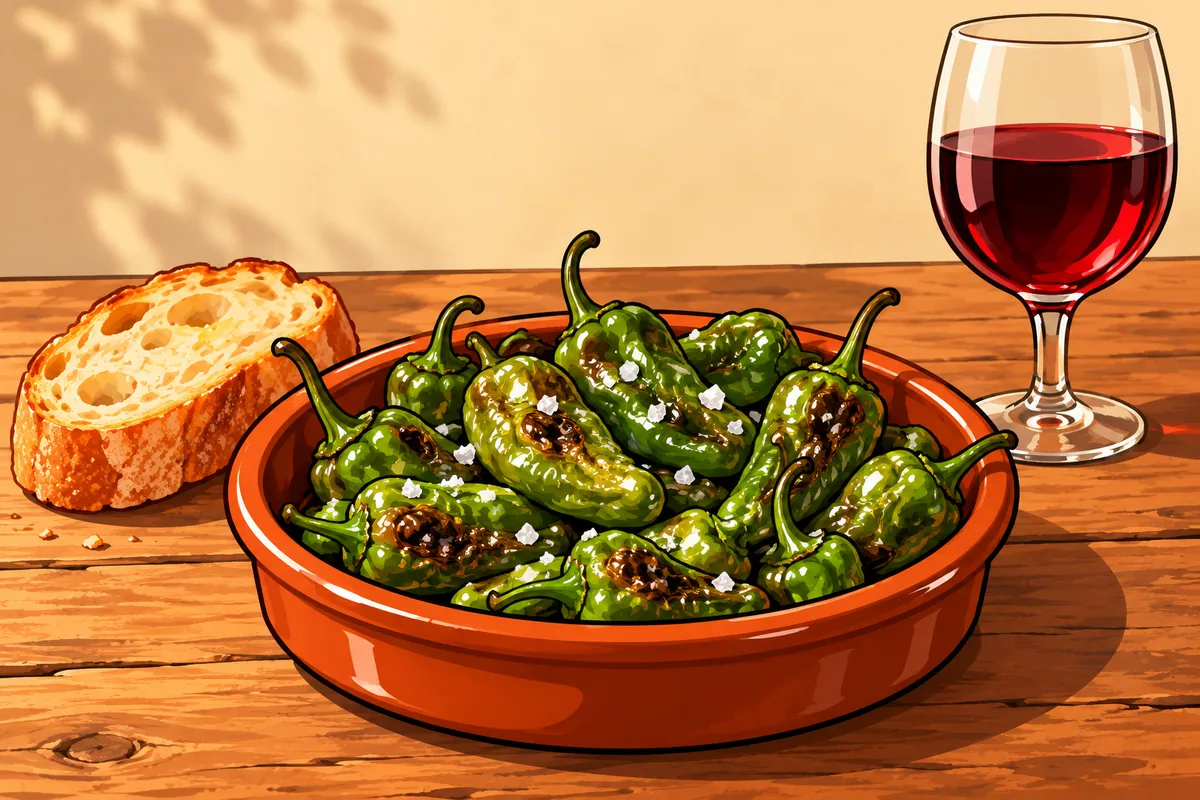
- A skillet tapa with coarse saltThe Padrón's home dish
- Use PadrónsMild
- Skewers, a grill or a stir-fryLonger pods sit flat and turn easily
- Use shishitosMild
- Guests who avoid all heatBoth can surprise; sort first
- Either one, sorted and tasted
Sources for this line2. Johnny's Selected Seeds, seller page for its own seed3. Xunta de Galicia, Axencia Galega da Calidade Alimentaria (AGACAL)4. University of California Agriculture and Natural Resources, UC Master Gardeners of Ventura County
If your shop sells only one of the two, buy it and cook it the other's way; your guests will notice the shape before they notice any change in taste. The blistered shishito method works for a skillet of Padróns, and the Herbón festival in early August fries its Padróns in giant pans and serves them with corn bread3.
Can you grow a Galician Padrón season next to a shishito row?
Yes, and the two calendars line up well. Herbón growers start seed from October to January and plant outdoors in April and May3. Johnny's shishito gives its first green fruit about 60 days after transplanting and red fruit at about 802.
- October–January
Padrón seedbeds
Herbón growers prepare seedbeds and sow through the winter, keeping the soil evenly moist until the seedlings come up.3
- February–March
Planting under cover
Unheated tunnels get their plants first, with picking from May.3
- April–May
Planting outdoors
Open-field Padróns go in, with picking from June or July.3
- About 60 days after transplanting
First green shishitos
Red ripe fruit follows at about 80 days.2
- 1 May to 31 October
Padrón selling season
The protected Herbón peppers sell inside this window, packed within 24 hours of picking and rarely after 48.3
Plan for bigger plants than the pods suggest: the specification describes Padrón plants of 80 to 100 cm outdoors and 150 to 200 cm under cover3. Give each its own row and water both at the base through hot spells, since the same specification links dry heat above 30 °C to hotter fruit. In your garden, that means a July heat wave with dry soil can make the pods you pick during it noticeably hotter.
Seed saving is easy with the Padrón, because the plant mostly pollinates itself3. Save seed only from your mildest plants, the way the Herbón growers do, and next year's crop keeps its gentle bite.
Your next step: buy a bag of whichever pepper your market has, sort it with the packers' checklist above, and fry a test handful before the rest. If you want your own plants next summer, the shishito growing guide takes you from seed to first picking, and if Padróns are what you can't find, the Padrón stand-ins list your options by weight.
Related in Compare
-
Poblano vs Anaheim Pepper, Up to 2× the Heat
Two mild green chiles that cooks mix up all the time.6 min read -
Cayenne vs Jalapeño, 7.5× the Heat and Swaps
One usually ends up in a jar of powder, the other in a fresh salsa.6 min read -
Ghost Pepper vs Habanero, Why the Ghost Is 2.8× Hotter
Same species, very different numbers.6 min read -
Poblano vs Jalapeño, 3.3× the Heat and When to Use Each
The big mild one and the small hot one.5 min read -
Serrano vs Habanero, the Habanero Is About 13× Hotter
A salsa chile against a hot sauce chile.6 min read -
Habanero vs Thai Chili, Why the Habanero Is 3× Hotter
A tiny hot chili against a fruity extra-hot one.5 min read
Sources
· 6
- 1Acta Horticulturae 939:315-322 (ISHS) Morphological characterization and determination of pungency in Capsicum spp. (Santos, Vasconcelos, Almeida, Dias Fernandes, Batista Leitão)
- 2Johnny's Selected Seeds, seller page for its own seed Shishito, Organic Shishito Pepper Seed (4227G)
- 3Xunta de Galicia, Axencia Galega da Calidade Alimentaria (AGACAL) Pliego de condiciones de la Denominación de Origen Protegida «Pemento de Herbón»
- 4University of California Agriculture and Natural Resources, UC Master Gardeners of Ventura County Ventura Garden to Table Series: Peppers
- 5Antioxidants (MDPI) Antioxidant Profile of Pepper (Capsicum annuum L.) Fruits Containing Diverse Levels of Capsaicinoids (Palma, Terán, Contreras-Ruiz, Rodríguez-Ruiz, Corpas)
- 6The Horticulture Journal 90(1) (Japanese Society for Horticultural Science) Parthenocarpy Induced Fluctuations in Pungency and Expression of Capsaicinoid Biosynthesis Genes in a Japanese Pungency-variable Sweet Chili Pepper 'Shishito' (Kondo, Hatakeyama, Sakai, Minami, Nemoto, Matsushima)