
Aji Panca vs Aji Amarillo, About 40× Apart in Heat
One yellow and hot, one burgundy and mild, often in the same pot.
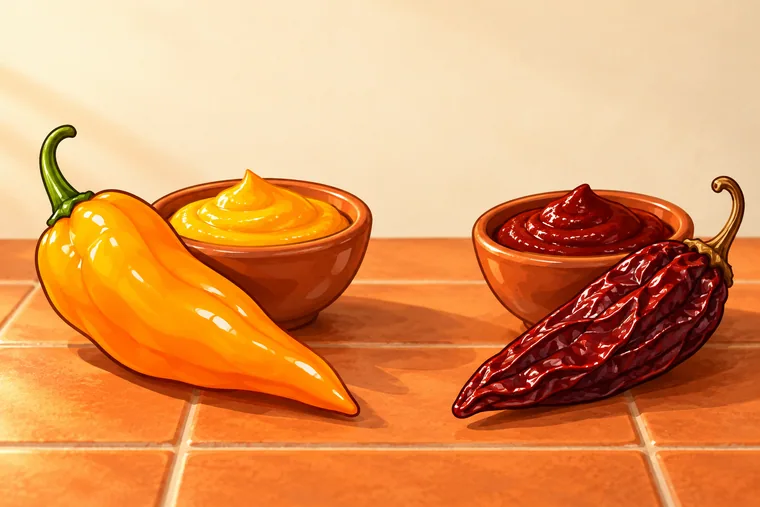
Aji amarillo is the hot one: 30,000–50,000 SHU against 500–1,500 for aji panca in one supplier's specs, about 40 times apart by midpoint.
- Amarillo brings heat and a yellow color; panca brings a deep red color and little heat
- Peruvian cooks use both in chupe, adobo and escabeche
- They do not swap for each other; blend them instead, and the table shows the heat of each mix
On this page
- 1How much hotter is aji amarillo than aji panca?
- 2How do the two pods differ in the market?
- 3Which Peruvian dishes use panca, amarillo or both?
- 4What heat do you get when you blend the two pastes?
- 5Why can't you swap aji panca for aji amarillo?
- 6Which of the two do Lima households buy more?
- 7Which jars and bags should you look for?
- 8How do you bring out the flavor of each pepper?
- 9How do you keep a jar of either paste from spoiling?
How much hotter is aji amarillo than aji panca?
About 40 times, going by one supplier's specs for its own dried pods and powders. PRODERNA rates its aji amarillo at 30,000 to 50,000 SHU1 and its aji panca at 500 to 1,500, one of the mildest chiles it sells2. The midpoints, 40,000 and 1,000, give the 40×.
Both ranges are one supplier's specs for its own dried pods and powder. Log scale; bars are published ranges.12
The bars do not come close: even the mildest amarillo sits 20 times above the hottest panca (30,000 ÷ 1,500). We found no university or peer-reviewed SHU range for either pepper, so treat the figures as a fair guide to the gap, not a lab verdict. The Bioversity market guide for Peru backs the direction, calling panca's pungency low3.
Because both figures describe dried product from the same company, you compare like with like. In your pot, amarillo is the heat and panca is the color.
How do the two pods differ in the market?
You can tell them apart from across the stall. Amarillo is orange or yellow and sold fresh or dried3; panca is a dark burgundy pod that cooks generally use dried23.
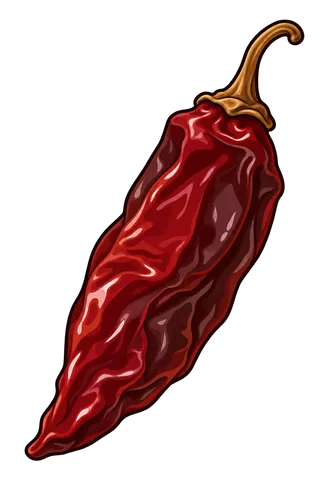
Aji panca
The species question has no clean answer for panca. The Bioversity guide lists amarillo under Capsicum baccatum var. pendulum, but places panca under C. chinense in one table and under C. baccatum in a photo caption3. Barboza's monograph lists "Ají Panca" among C. chinense names4, and PRODERNA calls it C. baccatum2. For your cooking the heat and color matter far more than the label.
PRODERNA notes that panca looks like amarillo when both are fresh and green2, so if you ever find fresh panca at a market abroad, the color at ripeness is your best tell.
Which Peruvian dishes use panca, amarillo or both?
Several of the classics take both. The Bioversity guide lists the dishes each pepper goes into, and chupe, adobo and escabeche appear on both lists3.
| Dish | Aji amarillo | Aji panca |
|---|---|---|
| Chupe (a chowder) | yes | yes |
| Adobo | yes | yes |
| Escabeche | yes, of fish or chicken | yes |
| Ají de gallina, causa limeña | yes | not listed |
| Cau cau, sudado, cebiche | yes | not listed |
| Carapulcra, pachamanca, parihuela | not listed | yes |
| Patita con maní | not listed | yes |
| Snack seasonings | not listed | yes, for its color |
Read the table by job. When a dish is yellow and has a kick, like ají de gallina, it is an amarillo dish. When it is deep red and mild, like carapulcra or pachamanca, it is a panca dish. When a recipe for chupe or adobo calls for both, each one is doing a different job, and you need both jars.
PRODERNA's spec sheets fit that split: amarillo for ceviches, salsas, sauces, chicken and seafood1, panca for gravies and seasonings2.
What heat do you get when you blend the two pastes?
You can dial it in by weight. If a paste carries the heat of its pepper, a blend's heat is the weighted average of the two midpoints, 1,000 SHU for panca and 40,000 for amarillo12. Here is every blend in steps of a quarter:
| Panca | Amarillo | Blend heat | How we got it |
|---|---|---|---|
| 100 % | 0 % | about 1,000 SHU | 1.00 × 1,000 |
| 75 % | 25 % | about 10,750 SHU | 0.75 × 1,000 + 0.25 × 40,000 |
| 50 % | 50 % | about 20,500 SHU | 0.5 × 1,000 + 0.5 × 40,000 |
| 25 % | 75 % | about 30,250 SHU | 0.25 × 1,000 + 0.75 × 40,000 |
| 0 % | 100 % | about 40,000 SHU | 1.00 × 40,000 |
Notice how quickly the amarillo takes over. A quarter of it already lifts the blend more than ten times above plain panca, so for a mild red adobo you might start at 10 % amarillo (about 4,900 SHU) and taste from there.
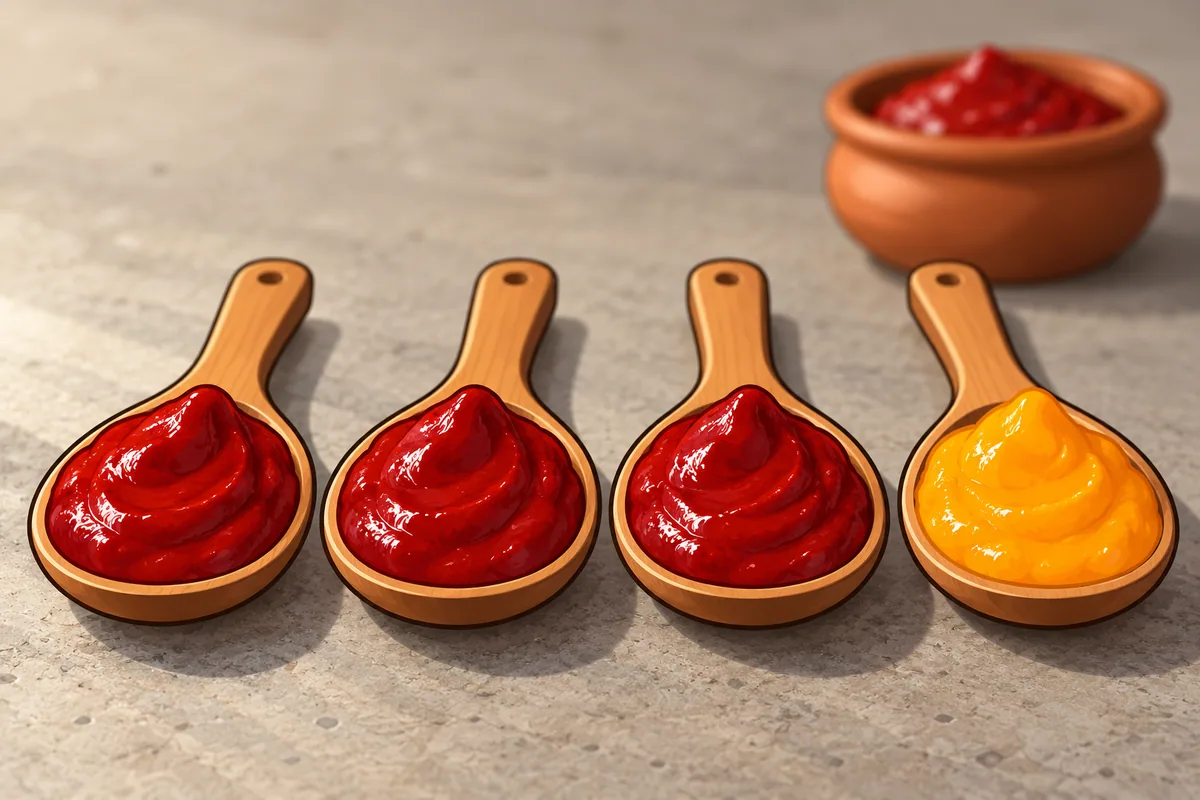
Here is a worked pot. Say your chupe recipe asks for 3 tablespoons of panca paste and 1 of amarillo, and your guests want it milder. That 3:1 mix is the 75/25 row, about 10,750 SHU. Drop to 3 tablespoons of panca and half a tablespoon of amarillo and you land near 6,600 SHU (3 × 1,000 + 0.5 × 40,000, divided by 3.5), cutting the heat by about two fifths while the red color stays almost the same, since panca still makes up most of the mix. The estimate assumes your two pastes weigh about the same per spoon, so weigh them once if you want to be exact.
Why can't you swap aji panca for aji amarillo?
Because each one takes away what the other gives. A straight swap changes either the heat or the color of the dish by a lot:
Panca in place of amarillo
If your shop has only one of the two, look for a stand-in that copies the missing job rather than the other aji. For panca's color and mild heat, a dried red chile does better than amarillo; for amarillo's heat and yellow, a hotter yellow or orange pepper does better than panca. The aji limo against the amarillo looks at the other Peruvian pepper you may find beside them, the one Bioversity says cooks use for hot sauces3.
Which of the two do Lima households buy more?
Amarillo, but panca is close behind, and the numbers explain why you see one jar far more often than the other. In the household survey the Bioversity guide reports, 89 % of Lima respondents ate aji amarillo and 75 % ate aji panca3.
Supermarket sales lean harder toward amarillo: at one Lima chain, it made up 95.2 % of native aji sales between August and October 20103. That pattern carries abroad. You will usually find amarillo paste in more shops than panca paste, so buy panca when you see it.
The same guide names the rocoto as the hottest of Peru's commercial ajíes3. If your recipe lists rocoto as well, it adds heat that neither of these two can match.
Which jars and bags should you look for?
Look for the same forms under both names. The Bioversity guide's survey of Lima supermarkets lists pastes, ground pepper and dried pods for both ajíes, from several Peruvian makers3:
| Form | Aji amarillo | Aji panca |
|---|---|---|
| Paste in a jar | 250 g and 220 g jars | 250 g jars |
| Ground (molido) | 10 g to 50 g packets | 10 g to 205 g packets |
| Dried whole pod | Sold as ají mirasol, 250 g | The usual form of panca |
| Ready sauce | Salsa de ají amarillo, 210 g | Not listed |
Read the label for the word mirasol. A jar or bag of "ají mirasol" holds the dried amarillo3, which keeps the heat and loses the fresh pod's water, so you need less of it by weight. A bag of panca powder, on the other hand, is simply the dried pod ground2, with the same mild heat.
If you cook Peruvian food often, a jar of each paste and a bag of each powder cover almost every recipe. The pastes give you color and body in a stew; the powders let you season a rub or a dry marinade without adding water.
How do you bring out the flavor of each pepper?
Treat them as the different products they are. PRODERNA suggests roasting or baking dried amarillo over low heat to bring out its natural oils1. Panca reaches you already dried twice, first on the plant and then in the sun2, which is where its smoky, berry-like note comes from in the supplier's description.
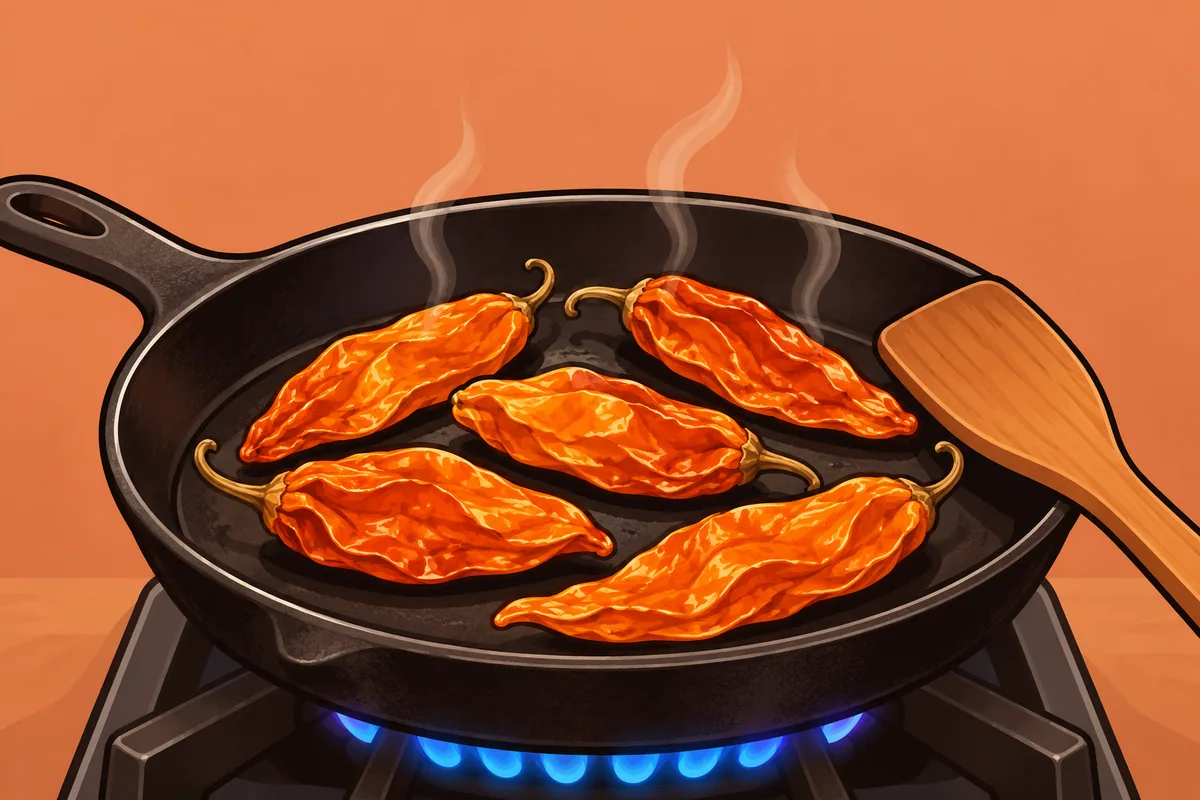
For a stew that uses both, one simple order of work keeps each pepper in its job: soften the panca paste in oil first for the color, then add the amarillo with the liquid so you can taste and stop when the heat is right. Because amarillo carries about 40 times the heat12, adding it last gives you the control.
How do you keep a jar of either paste from spoiling?
Treat a homemade paste like any chile purée. NMSU says to refrigerate leftover purée promptly and to use or freeze it within 3 days5, and to skip any dried pod with mold, insects or decay before you soak it5.
If you make panca paste from dried pods, the soak is the same as for other dried red chiles: cover stemmed, seeded pods with boiling water for 30 minutes, blend with fresh hot water, then simmer 10 minutes5. For fresh amarillo, wear rubber gloves while you seed the pods and keep your hands away from your eyes6. At 30,000 SHU and up, it sits right in the cayenne band of 25,000 to 50,0007, so handle it the same way.
Your next step: decide which job your dish needs (heat, color or both), pick a row in the blend table, and test a teaspoon of each paste before you fill the pot. If a recipe also calls for the small, hot Peruvian aji limo, weigh it against amarillo first, since Bioversity groups it with the peppers for spicy sauces3.
Related in Compare
-
Aji Limo vs Aji Amarillo, Two Species at 50,000 SHU
Two Peruvian ajíes, one heat band, two different plants.6 min read -
Chile Manzano vs Habanero, Close in Heat at 175,000 SHU
An apple-shaped mountain chile and a lantern-shaped lowland one, about as hot as each other.6 min read -
Cayenne vs Jalapeño, 7.5× the Heat and Swaps
One usually ends up in a jar of powder, the other in a fresh salsa.6 min read -
Calabrian Chili vs Fresno, Up to 4× Hotter by EU Rules
A protected Italian name that covers a whole region's chiles, against one Californian cultivar.6 min read -
Habanero vs Cayenne Pepper, About 6× Hotter
Two different species, and a gap between their ranges.5 min read -
Cayenne vs Thai Chili, Why the Smaller Pod Is 2× Hotter
Same species on most lists, double the heat, a sixth of the length.5 min read
Sources
· 7
- 1PRODERNA (J.H. Lüttge GmbH), ingredient supplier, spec for its own product AJI AMARILLO (whole and powder)
- 2PRODERNA (J.H. Lüttge GmbH), ingredient supplier, spec for its own product Panca (whole and powder)
- 3Bioversity International, with INIA and Peru's Ministry of Agriculture and Irrigation Guía de oportunidades de mercado para los ajíes nativos de Perú (Jäger, Jiménez, Amaya, compilers)
- 4PhytoKeys 200:1-423 (Pensoft) Monograph of wild and cultivated chili peppers (Capsicum L., Solanaceae)
- 5New Mexico State University Cooperative Extension Service (Guide E-327) Making Red Chile Purée and Sauce from Dried Pods
- 6New Mexico State University Cooperative Extension Service (Guide E-324) Processing Fresh Chile Peppers (revised by Nancy C. Flores)
- 7UF/IFAS Gardening Solutions Peppers by Scoville Units